
- Chronology
- Before 1500 BCE
- 1500 BCE to 500 BCE
- 500 BCE to 500 CE
- Sixth to Tenth Century
- Eleventh to Fourteenth Century
- Fifteenth Century
- Sixteenth Century
- Seventeenth Century
- Eighteenth Century
- Nineteenth Century
- Twentieth Century
- Twenty-first Century
- Geographic Area
- Africa
- Caribbean
- Central America
- Central and North Asia
- East Asia
- North America
- Northern Europe
- Oceania/Australia
- South America
- South Asia/South East Asia
- Southern Europe and Mediterranean
- West Asia
- Subject, Genre, Media, Artistic Practice
- Aesthetics
- African American/African Diaspora
- Ancient Egyptian/Near Eastern Art
- Ancient Greek/Roman Art
- Architectural History/Urbanism/Historic Preservation
- Art Education/Pedagogy/Art Therapy
- Art of the Ancient Americas
- Artistic Practice/Creativity
- Asian American/Asian Diaspora
- Ceramics/Metals/Fiber Arts/Glass
- Colonial and Modern Latin America
- Comparative
- Conceptual Art
- Decorative Arts
- Design History
- Digital Media/New Media/Web-Based Media
- Digital Scholarship/History
- Drawings/Prints/Work on Paper/Artistc Practice
- Fiber Arts and Textiles
- Film/Video/Animation
- Folk Art/Vernacular Art
- Genders/Sexualities/Feminisms
- Graphic/Industrial/Object Design
- Indigenous Peoples
- Installation/Environmental Art
- Islamic Art
- Latinx
- Material Culture
- Multimedia/Intermedia
- Museum Practice/Museum Studies/Curatorial Studies/Arts Administration
- Native American/First Nations
- Painting
- Patronage, Art Collecting
- Performance Art/Performance Studies/Public Practice
- Photography
- Politics/Economics
- Queer/Gay Art
- Race/Ethnicity
- Religion/Cosmology/Spirituality
- Sculpture
- Sound Art
- Survey
- Theory/Historiography/Methodology
- Visual Studies
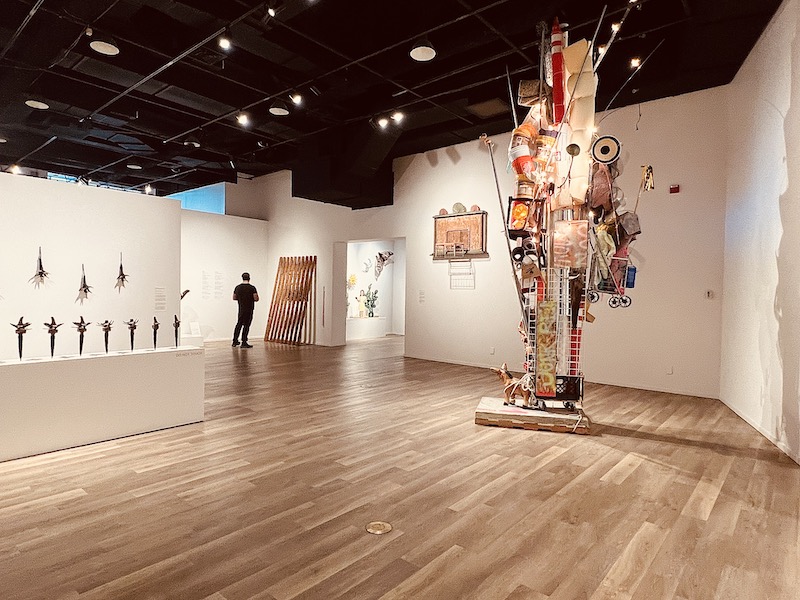
Guest curated by Rigoberto Luna on exhibition at the Tucson Museum of Art (TMA), Ya Hecho: Readymade in the Borderlands; Ya Hecho: Confeccionado en las Tierras Fronterizas centers on the politically fraught landscape of the US-Mexico border. Amplifying the symbolic potential of materials, the exhibition draws from the assemblage aesthetic of rasquachismo, a Chicano style embodying resilience, as well as the underlying concept of the Duchampian readymade. The use of the term readymade serves as a form of material shorthand referencing the found objects utilized in the artworks. However, thematically, the exhibition more directly engages in the class politics of rasquachismo than the self-referential aesthetic discourse surrounding the readymade. Importantly, the term rasquachismo is derived from the Spanish word rasquache, a classist slur translated as “cheap” or “trashy.” A fundamentally hybrid aesthetic, rasquachismo reclaims discarded objects, complicating the instability of meaning through its interrogation of dominant cultural values. Ultimately, the multivalent title of the exhibition evokes the pervasive sense of cultural hybridity characterizing the artworks themselves. Alternating between dialects and cultural codes, this sense of hybridity resonates throughout the exhibition, an interplay manifest materially and narratively. Appropriately, the interpretive wall text and labels are provided in both English and Spanish. Imbued with meaning, the quotidian objects utilized evoke themes connected to both the human and physical landscape of the borderlands, diasporic stories of identity, loss, and survival.
On view in the James J. and Louise R. Glasser and Earl Kai Chann Galleries, Ya Hecho begins with Puto Vicio/Fucking Vice (2023) by Gil Rocha, an embodiment of the overall sense of duality characterizing the exhibition. Combining hand-stenciled text with discarded objects, the assemblage evokes, in the words of the artist, a sense of “beauty and brutality,” and seems playful yet potent. Rather than focusing on the border as a geopolitical divide, Rocha describes it as a fluid space, and one characterized by the people, cultures, and histories traversing its landscape. Multivalent, the materials presented in combination create layers of complex meaning, culturally coded yet broadly communicable. Fashioned from found objects, the makeshift form of the basketball net is repeated in multiple works nearby. Subversive, the discarded objects infuse a sense of gravity, as the viewer draws near in an attempt to decipher the semiotic whole communicated through thoughtfully arranged, though seemingly disparate parts. Employing objects commonly perceived as refuse, including an actual garbage bag, the materials question dominant cultural values.
Organized thematically, the exhibition begins with the first of four curatorial themes, “Materiality of Place/Materialidad del Lugar,” its most expansive theme, and one that resonates throughout the exhibition. In this section, materiality embodies resistance through hybrid cultural forms and motifs. To the right of the introductory wall, galleries are formed along a spiraling descent. Generally, the limitations of the gallery spaces complicate the exhibition layout, rendering it somewhat awkward and disjointed, particularly in dividing the works thematically. Although a potential distraction, at times, the spatial complexity seems appropriate for the liminality explored in the works themselves.
Within this liminal space, Deeply Rooted in Machismo/Profundamente Arraigado en el Machismo (2025) by José Villalobos is featured. Throughout his oeuvre, Villalobos explores the destructive impact of machismo on Norteño culture. Constructed of leather vaquero (cowboy) boots affixed to the wall, disentangled ropes emerge from the soles of the boots, creating an interplay of roots that seem to constrict while grounding the piece. An evocative material, rope connotes strength but also violence. This sense of ambivalence metaphorizes the complexity of the artist’s relationship to culture and place. As a queer artist, Villalobos attempts to reconcile the damaging influence of archetypical masculinity within his dual Mexican and American cultures, deconstructing the performative aspects of gender as a sociocultural construct.
In the large-scale sculpture Junk Removal/Eliminación de Chatarra (2023–2025), Lorena Ochoa directly engages with the politics of rasquachismo while confronting the colonial legacies of continued violence and erasure. As a diminutive concrete burro labors under the weight of a seemingly impossible burden, the artist metaphorizes the psychological weight carried within the migrant body, which Ochoa describes as a “vessel of memory, tradition, and inherited trauma.” Monumental in scale, the towering assemblage includes household items such as a chair, stool, and table lamp, which are haphazardly arranged amidst an array of discarded items labeled as junk, including a road sign and traffic cone. The jumbled burden perches precariously atop wheels that seem insufficient to the task, as the miniature burro is partially obscured by the length of the heavy rope that binds him to his burden. The conflation of the migrant body with its devalued burden serves as a condemnation of the treatment of the migrant.
A second theme within the exhibition, “Land and Labor/Tierra y Trabajo” engages with the inextricability of the land and agricultural labor. Incorporating found produce boxes employed as unconventional foundations, Narsiso Martinez draws from his experience as a farm worker, creating linocut prints such as Do Not Chill, Do Not Frieze, No Ice/No Enfriar, No Congelar, Sin Hielo (2017–2024). Depicting a farm worker whose face is obscured by a makeshift agricultural mask, the artist confronts the pretense of justice in the immigration debate by amplifying the exploited migrant workers who form the backbone of American food production. A critique of political and economic injustice, the linocut prints draw from the tradition of social realism popularized during the 1930s by artists such as Diego Rivera, who created emblematic and heroic images of laborers. Enveloped by a gilded background, the linocut figure of the farm worker contrasts brightly against the surrounding richesse, a disparity further emphasized by the humble cardboard.
An adjoining theme, “Movement & Migration/Movimiento y Migración,” transitions to the adjacent gallery space. Among the included works, the viewer will find siempre estuve aquí,/I was always here (2025), a collaboration between Andrés Caballero and Vanessa Saavedra. The installation confronts the material rigidity of the border wall, the efficacy of which seems predominantly ideological, serving as an internalized symbol of imperialist dominance. The artists reimagine the wall, playfully transforming hardened steel into the plush delicacy of a piñata. As found throughout the exhibition, the choice of materials is culturally coded and subversive. As a piñata stick hangs limply nearby, the vulnerability of the impotent papered structure interrogates the solidity of the reasons behind the construction of the border wall.
Brinco/Jump (2005) by Judi Werthein emphasizes the often-ignored humanitarian crisis at the border. Werthein created a sneaker that serves as a comprehensive navigation tool to assist migrants crossing the United States border into California. As the installation details, a border map, compass, and light are housed within the shoe. As demonstrated in the news, stories streamed across a television near the glass-encased sneaker Brinco/Jump (2005) created a firestorm of controversy. Accusing the artist of potentially aiding a criminal act, the television journalists react in shock and alarm during their interview with Werthein. Ultimately, the focus on the perceived criminality of the sneaker underscores the perilous circumstances experienced by those crossing the border, a humanitarian crisis overshadowed by politics.
Within the fourth and concluding theme, “Beyond Borders/ Superación de las Fronteras,” diaspora is approached as a nonlinear dialogue and transhistorical engagement with issues concerning identity and migration. In Tiricia de lo que nunca fue, de lo que nunca murio/Nostalgia of What Never Was, of What Never Died (2025), Frederico Cuatlacuatl reclaims his Nahua lineage through a hybrid aesthetic integrating varied cultural motifs. In the assemblage, a taxidermied turkey, with a singular foot bound to a machete, dangles ominously from the fringed brim of a richly festooned straw hat. First domesticated in the Americas for the ritual value of its feathers, the turkey predates colonization. An indigenous bird, the turkey later became central to American Thanksgiving festivities, appropriated as a symbol of colonial dominion. As a former undocumented immigrant and Deferred Action for Childhood Arrivals (DACA) recipient, Cuatlacuatl confronts colonial violence and the marginalization of Indigenous peoples, drawing parallels to contemporaneous political relations between the US and Mexico.
Adeptly curated, Ya Hecho: Readymade in the Borderlands; Ya Hecho: Confeccionado en las Tierras Fronterizas challenges prevailing assumptions surrounding the US–Mexico border while amplifying the voices of those who both traverse and inhabit the borderlands. The multivalence of the exhibited artworks serves as an embodiment of the cultural hybridity characteristic of the borderlands and more broadly, the United States. As the current administration funds Immigration and Customs Enforcement (ICE) at an unprecedented level, authoritarian displays of force continue throughout the country. Through racialized violence, the humanitarian crisis at the border has expanded geographically with an unprecedented level of detentions and deportations. As a country, we have effectively become the borderlands. In coordination with the exhibition, the Tucson Museum of Art commissioned four poems inspired by each of the curatorial themes. Consummately, Ya Hecho attests, as Logan Phillips affirms in his Materiality of Place poem, “This land isn’t the border, a border was inflicted on this land; esta tierra no es la frontera, una frontera fue impuesta sobre esta tierra.”
Sarah Greenwell-Scott
The University of Arizona